

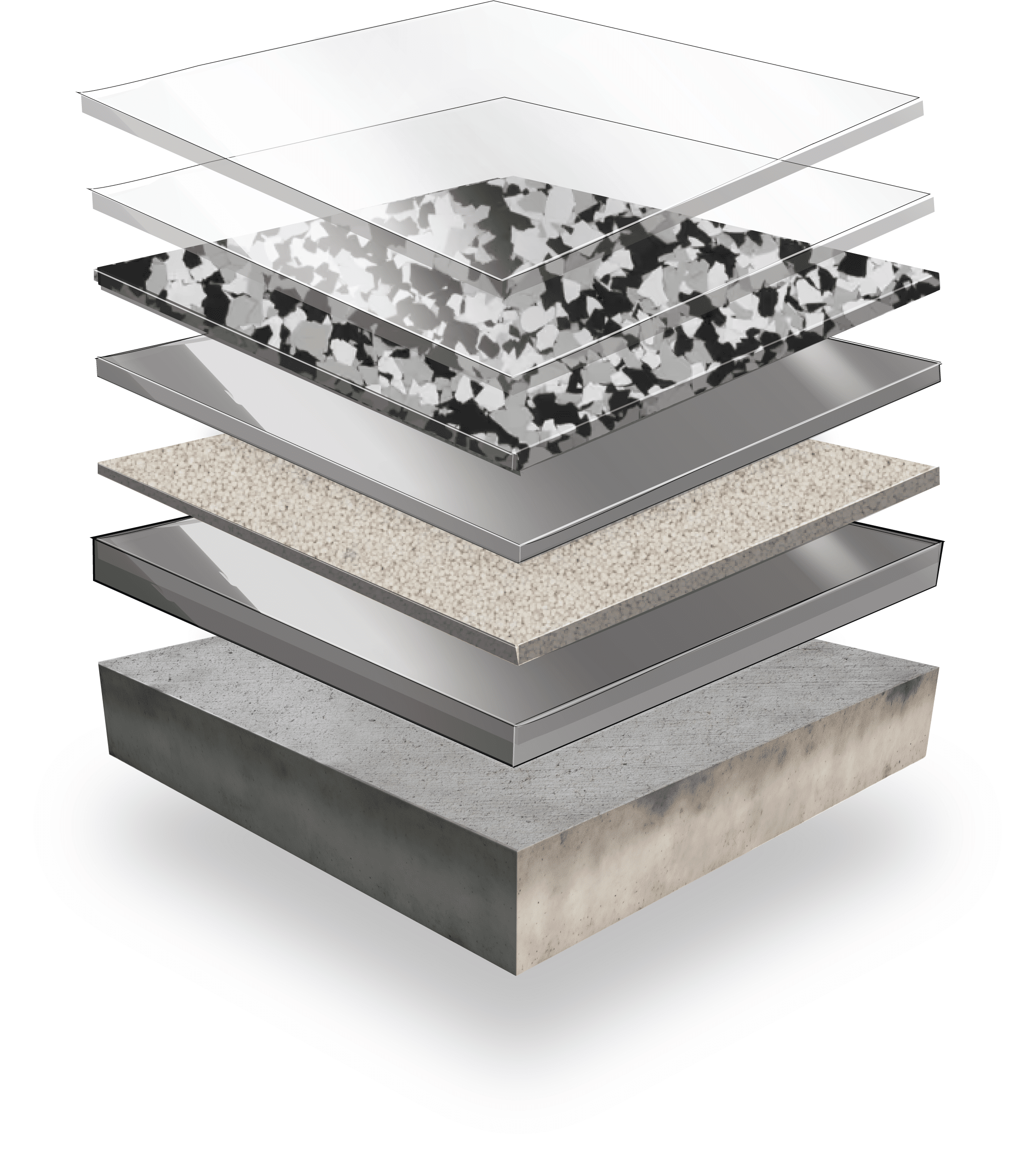
CrownCrete 818 UEF
CrownCrete 818 UEF is a multi-layer moisture control and decorative flake floor system, starting with a self-leveling, three-component cementitious urethane slurry broadcast with aggregate to create a moisture vapor tolerant barrier. The second layer adds a pigmented epoxy binder broadcast with colored vinyl flake and sealed with a clear epoxy or UV-stable topcoat, offering customizable blends, double-broadcast options for added thickness, integral cove base, and variable texture for slip resistance — typically installed at 1/8″–3/16″ (3.2–4.8 mm).
Description
CrownCrete 818 UEF is a multi-layer moisture control and decorative flake floor system, starting with a self-leveling, three-component cementitious urethane slurry broadcast with aggregate to create a moisture vapor tolerant barrier. The second layer adds a pigmented epoxy binder broadcast with colored vinyl flake and sealed with a clear epoxy or UV-stable topcoat, offering customizable blends, double-broadcast options for added thickness, integral cove base, and variable texture for slip resistance — typically installed at 1/8″–3/16″ (3.2–4.8 mm).
System Build
-
Basecoat
818 CrownCrete U 1/8”
-
Broadcast
Flintshot or Natural Quartz Broadcast
-
Build Coat
8320 CrownShield™ Pigmented Epoxy
-
Broadcast
Colored Flake Broadcast
-
Grout Coat
8320 CrownShield™ Clear Epoxy
-
Topcoat
8320 CrownShield™ Clear Epoxy
Typical Uses

Pharmaceutical Facilities

Food Processing Areas

Commercial Kitchens

Public Spaces

Factories

Hospital, Labs, and Health Care Facilities

Cafeterias
Lobbies

Classrooms
Benefits
- Can be applied over 7-10 day partially cured concrete substrates.
- Can be applied to concrete substrates where <99% relative humidity is measured as per ASTM F2170.
- Substrate has tensile bond strength in excess of 218 psi.
- Resists a very wide range of organic and inorganic acids, alkalis, amines, salts, and solvents.
- Similar coefficient of thermal expansion to concrete allowing movement with the substrate through normal thermal cycling.
- It will perform and retain its physical characteristic through a wide temperature range from -40° F (-40° C) up to 248° F (120° C).
- Behaves plastically under impact / deforms but will not crack or debond.
- High abrasion qualities result from its aggregate structure.
- Minimal maintenance costs, superior life cycle cost advantage versus tile.
- Meets the requirements of USDA for use in food plants